
Gianna Galdieri: Bridging Carbon Markets, Science, and Social Justice

For Gianna Galdieri, environmental policy has always been about people. As an M.S. in Environment & International Affairs student concentrating in Global Environmental Science and Policy, Gianna is building a career at the intersection of environmental science, carbon markets, and social justice. Her work centers on a critical question: how can climate solutions be designed in ways that are scientifically rigorous while also equitable for the communities most affected by them?
Originally from New Jersey, Gianna’s interest in environmental issues began early. Growing up near the coast, she experienced hurricanes and other climate-related disasters firsthand, shaping her awareness of environmental vulnerability and resilience. Even as her interest in climate science grew, she never wanted to separate environmental issues from their social dimensions:
“I wanted to keep one foot in science and one foot in policy,” she explains. “A lot of programs make you choose one or the other, but I’ve always wanted to study how they merge together.”
That interdisciplinary mindset first took shape during her undergraduate studies at George Washington University, where she studied Human Services and Social Justice alongside Sustainability. At the time, few students were combining those fields, but Gianna saw clear connections between environmental systems and social inequities. In one sociology course on Race and Minority Relations, she examined toxic air pollution in Washington, D.C.’s Wards 7 and 8 and its disproportionate impacts on Black and Hispanic communities.
“No one else in the class really had an environmental background… it became an opportunity to connect those fields in a policy-forward way.”
That same interdisciplinary focus ultimately drew her to Georgetown’s MS-EIA program. Gianna says she was looking for a graduate program that would allow her to continue integrating science, policy, and human-centered environmental work rather than forcing those interests into separate tracks. Within the program, she has found a community of students and faculty similarly interested in the intersection of environmental systems, governance, and equity.
“As time has gone on, I’ve had the chance to meet more people interested in the human aspect of environmental policy, especially at Georgetown,” she says.
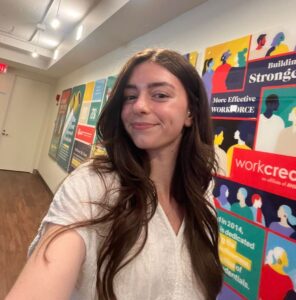
Before joining Georgetown, Gianna worked as a GHG Technical Coordinator for an accreditation board supporting greenhouse gas verification and conservation projects within carbon markets. There, she focused on how projects are evaluated and how methodologies are developed and applied across different ecosystems. The experience deepened both her technical expertise and her awareness of the broader social implications of carbon offset projects and conservation work.
Her interests are particularly rooted in coastal and marine ecosystems, which she believes are often overlooked in climate conversations dominated by forest conservation. She points to emerging research on kelp and seaweed carbon sequestration as an example of how “the science is catching up” in blue carbon systems.
“Science travels,” she says. “A forest methodology developed in one country can influence projects around the world, and coastal pilot projects can have implications elsewhere too. But the questions travel with the science — who benefits, who is included, and how communities are impacted.”
Gianna Galdieri
Those questions have become central to her academic and professional goals. Gianna is especially interested in how global carbon market projects and conservation policies affect Indigenous communities and local stakeholders, particularly as climate finance mechanisms continue to expand globally.
The science behind carbon reduction projects is incredibly important in terms of permanence and additionality,” she says. “But so are the people. I worry that policies and methodologies are sometimes implemented before the human side of projects is fully investigated.”
At Georgetown, Gianna has continued developing both the technical and policy skills needed to address those challenges. Through the MS-EIA program, she has strengthened her abilities in GIS and statistical coding in R, tools she sees as essential for critically evaluating environmental projects and conservation claims. “I’m interested in using GIS and R to interrogate some of the spatial assumptions underlying carbon and conservation projects,” she explains. “Where is forest cover actually changing? How are project boundaries drawn? Where can we do the most impactful work? Technical skills can change how people read a project and assess whether the data really holds up.”
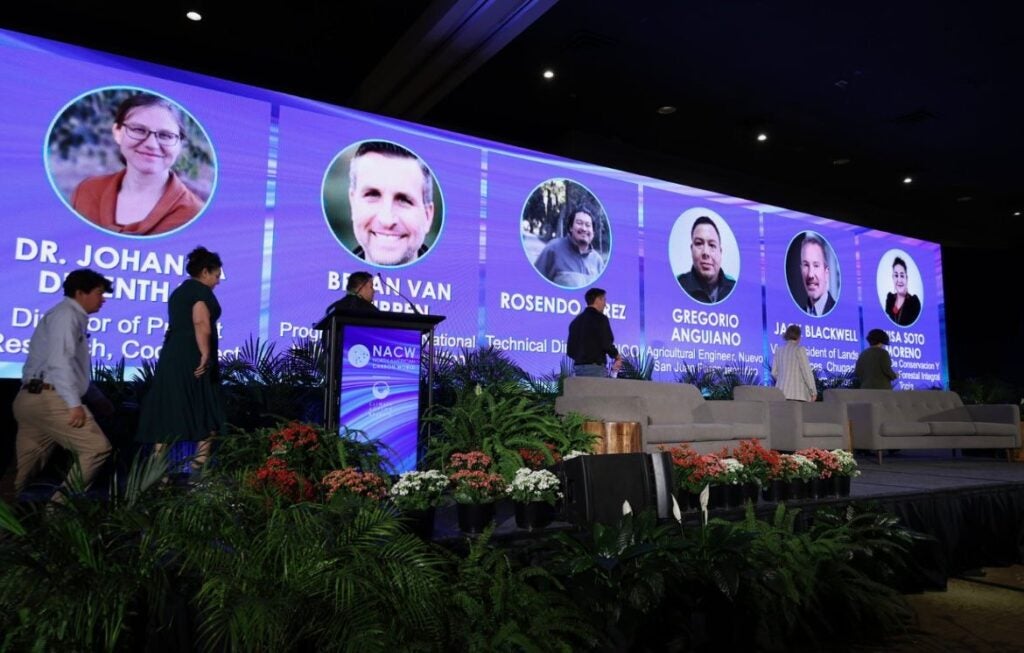
Recently, Gianna attended the North American Carbon World conference for the first time, an experience she describes as formative both as a student and an emerging practitioner. Speaking directly with registries, project developers, and others working in carbon markets gave her a clearer understanding of how projects are measured, designed, and implemented in practice.
At the same time, the experience reinforced the importance of integrating human rights and community consultation into climate policy from the beginning, not as an afterthought: “I think consulting with Indigenous communities before policies and projects are enacted is integral both to the project and to the ecosystems they affect, scientific integrity is incredibly important, but so is the care we put into communities.”
For Gianna, the future of environmental policy lies in refusing to separate technical rigor from social responsibility. As carbon markets and climate solutions continue to evolve, she hopes to contribute to a field that values both scientific integrity and environmental justice equally:
“The field is still being built…we have the opportunity to build one that truly cares for our common home.”