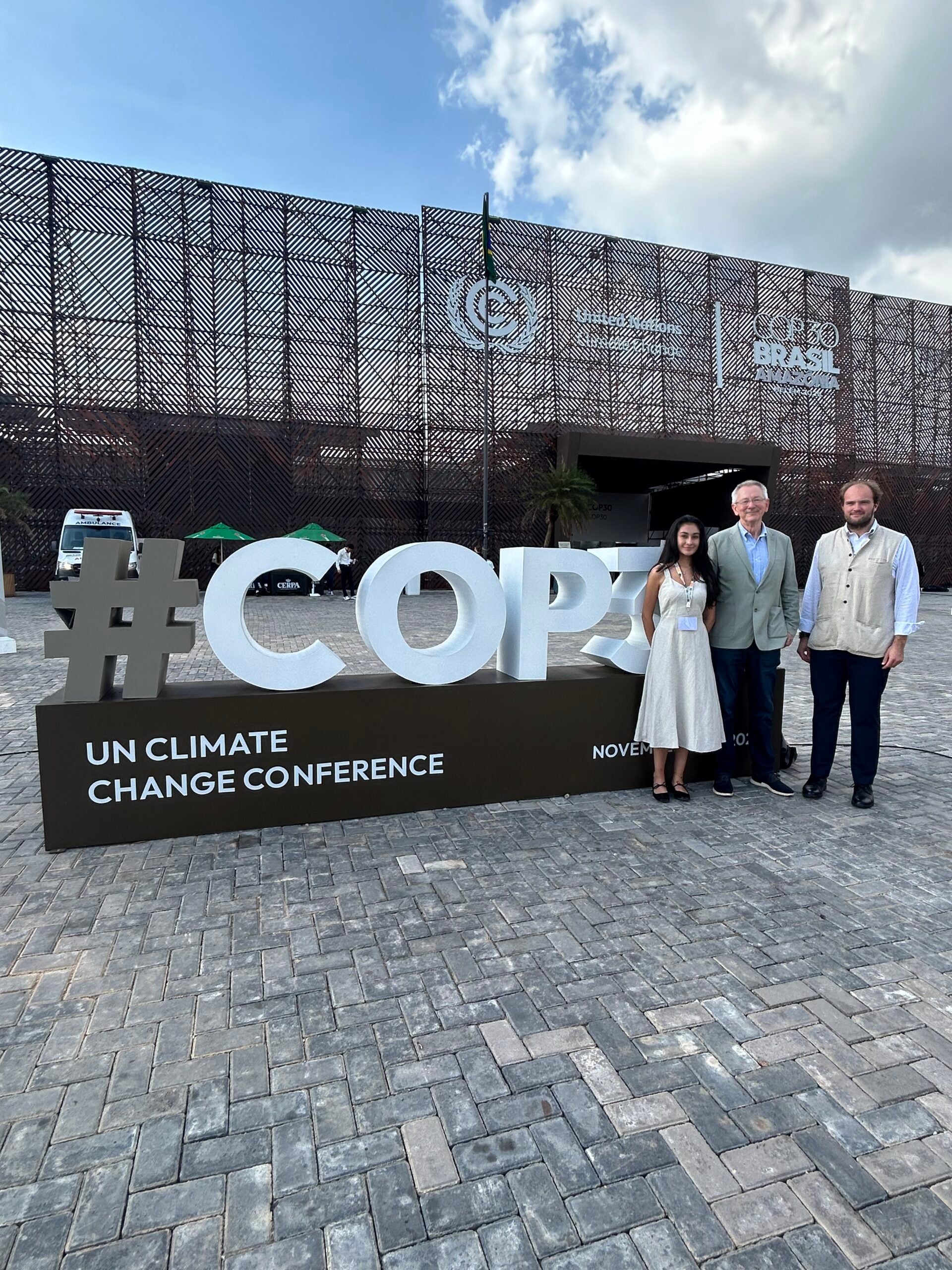
A delegation of students from Georgetown University’s School of Foreign Service (SFS) recently had the opportunity to attend the 30th Conference of the Parties (COP30) in Belém, Brazil, where world leaders, policy practitioners and climate experts convened to tackle the challenges posed by climate change. Amineh Najam-ud-din (MS-EIA’26) was selected to attend this year’s CoP on behalf of the MS-EIA Program, the School of Foreign Service, and the Earth Commons.
Amineh Najam-ud-din: MS-EIA on the Ground at CoP30
Amineh Najam-ud-din (MS-EIA‘26)
Amineh joined the MS-EIA program with a B.A. in International Relations from Boston University’s Pardee School of Global Studies, with a specialization in international law and public policy analysis. Upon graduation, Amineh traveled to Pakistan to intern with Supreme Court Justice Syed Mansoor Ali Shah on the digitization of Pakistan’s judiciary and the future of sustainability in the country. Prior to joining the MS-EIA program, she worked as a Program Manager for the Center for Strategic and International Studies’ (CSIS) Humanitarian Agenda, where she developed an interest in climate finance and adaptation efforts in conflict contexts.
For Amineh Najam-ud-din, the MS-EIA program representative at CoP30, attending the conference was a pivotal experience. “I’ve had the chance to study the Paris Agreement, NDCs, The Loss and Damage Fund- but getting to see how agreement texts were discussed during negotiations was really incredible… it’s certainly slow-moving, but every tweak to agreement texts is intentional, and comes out of intense debate amongst country delegations… every actor is balancing domestic priorities and international cooperation.”
Innovation and Partnership at CoP
Having joined the MS-EIA program with the goal of developing a technical toolkit to translate science into actionable and equitable policy, Amineh had the opportunity to see first-hand how science and policy work hand in hand at CoP30. “It’s clear that the science community is gearing up for climate resilience, and offering truly innovative, transformative solutions- but without the funding to get there,” Amineh shares. “There’s a challenge here but also an opportunity- it seems like cross-sectoral collaboration and strong partnerships for climate financing may be the key.”
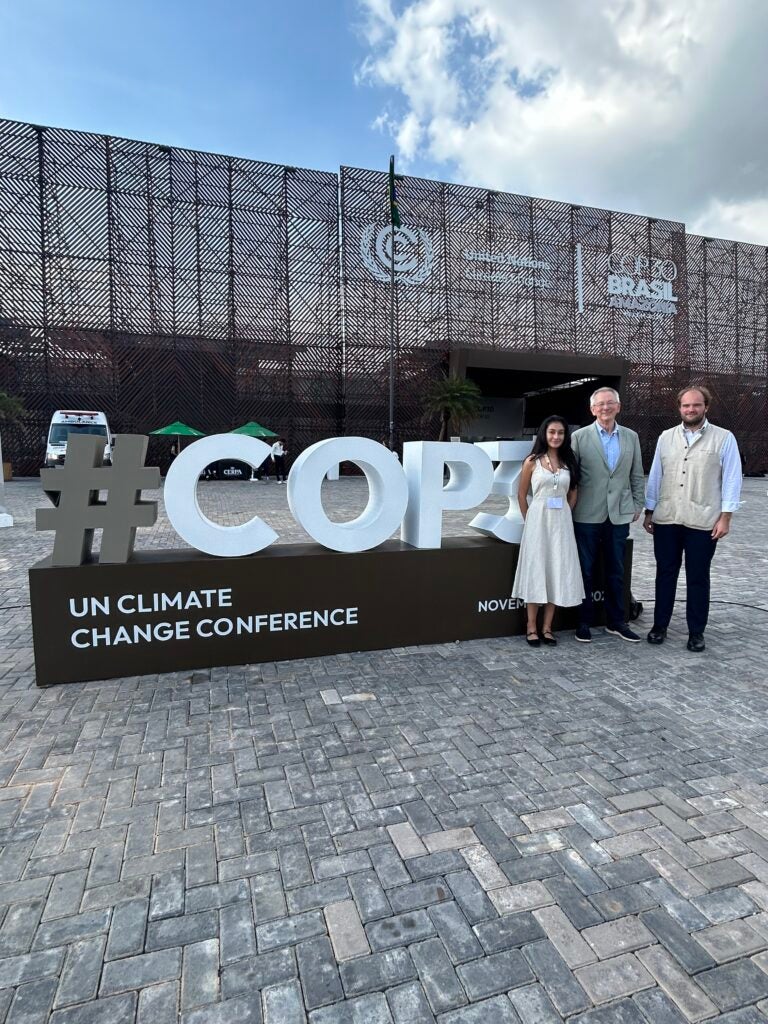
MS-EIA Students with Sir Andrew Steer at CoP30
Amineh’s experience at CoP highlighted the urgent need for partnerships and identifying synergies across sectors. She had the opportunity to emcee for two of Recharge Pakistan’s sessions at CoP30- an ecosystem-based adaptation and green infrastructure project aimed at flood and drought risks in Pakistan, and a flagship partnership between the Government of Pakistan, the Green Climate Fund, The Coca-Cola Foundation, and WWF. “This is a great example of working across sectors to create environmental and economic initiatives- garnering private and public investment, future-proofing businesses, and promoting localized ownership and capacity building.”
Defining Features of CoP30
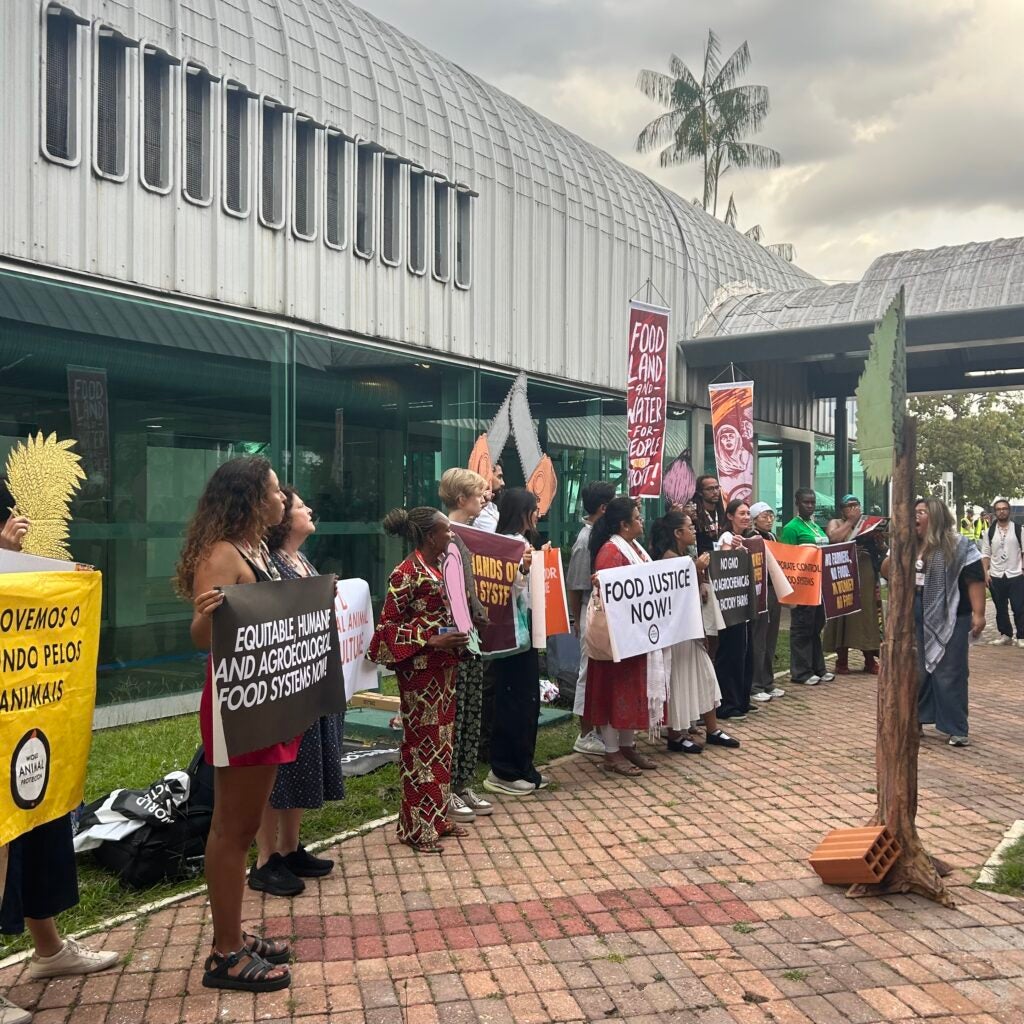
Indigenous Protest at CoP30 in Belèm
This CoP- widely dubbed as the “Forest CoP” and “Indigenous peoples’ CoP”- emphasized the importance of forests for mitigation, and the need for local knowledge and investment. “Indigenous presence and Indigenous-led protest took center stage at this year’s CoP,” says Amineh. Indigenous practices and local knowledge were a common thread across country-level and NGO proposals, and were acknowledged in the development of National Adaptation Plans (NAPS) during High Level/Ministerial meetings. Brazil also launched the Tropical Forest Forever Facility (TFFF) at CoP, an initiative “…that uses investment returns to value the global public services provided by tropical forests and reward countries for their conservation.” “TFFF offers incentive to donor states by offering investment returns,” Amineh shares. “It also offers a great partnership framework between national governments and indigenous communities”.
The Path Forward
Amineh recognizes that there is much more work to be done. “The final agreement that came out of CoP30 didn’t mention fossil fuels… around 80 countries demanded a phase-out roadmap, but petrostates like Saudi Arabia and Russia led an opposition and ultimately won.” Despite this disappointment, she says that this year’s CoP highlighted some critical insights:
“Innovation is alive and well at CoP. I sat in on conversations on parametric insurance plans to address loss and damages in eco-vulnerable, developing countries- especially coming out of Hurricane Melissa in Jamaica, which is currently receiving pay-outs from these plans… these sorts of innovative strategies are what brings me hope for future climate action”
“Local voices must be at the center of climate action. Local data and local narratives are key for global movement – we must build a shared vision locally to pull investment.
“Finance is key. Climate financing and private sector inclusion are necessary for moving the ball forward. We need cross-sectoral collaboration, and CoP30 solidified that there is indeed an appetite for it, if and only if all actors are able to collaborate in project design.”